Top Five things to see in Berlin, Germany
I went to Berlin, Germany, for the first time this summer and it was such a great experience. Berlin is a culturally rich city with lots of things to do and it’s easy to do it on your own (or with friends/family). I went with my mom and brother and met up with my brother’s friend, Dovi, who has been living in Berlin for a couple of years. He showed us around the city all week and from our “insider’s tour,” I made a top five list of places you MUST see when you visit. In another post, I’ll have other notable places.
Berlin is an easy city to get around on foot or by subway. On the first day we were in the city, my brother and I took the subway to get around:
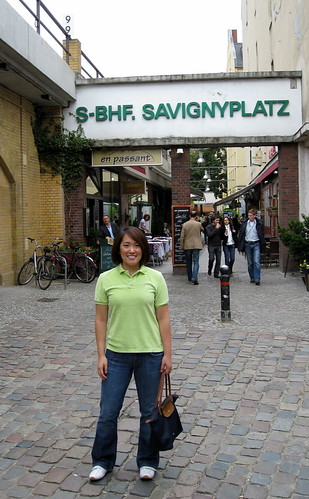
The subways are partially elevated and partially underground and the train cars are very short compared to the ones in New York. One interesting thing about the Berlin subway system is that it’s all based on trust – they don’t have gates that you have to pass through or anything! You have to buy a ticket and get it validated before heading onto the train, but no one checks! Well, there are people that OCCASIONALLY check, but I’m guessing it’s not very often. But, I wouldn’t recommend not validating your ticket because if you get caught, it’s a 40 euro fine (which is a little more than $40USD). A great thing about the Berlin subways is that even though it’s underground in parts, you can get cell phone/blackberry service everywhere.
1. Brandenburg Gate/DZ Bank/Reichstag/Holocaust Museum (okay, I cheated because technically that’s four different places, but they’re all very close to each other so you can catch all of them in one short walking tour).
a. Our first stop was the Brandenburg Gate:
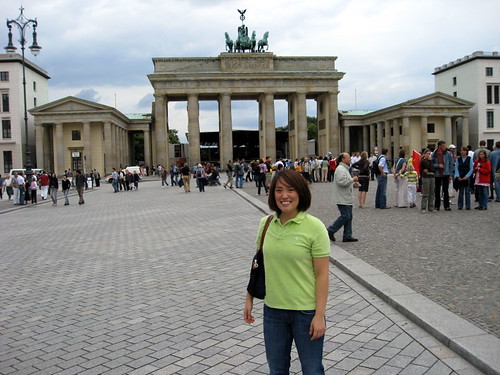
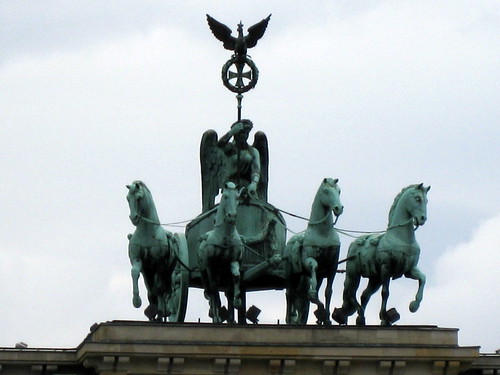
The Brandenburg Gate is one of the major historical landmarks in Berlin. If you don’t know the history, you can look it up here. I pulled this from wikipedia to give you a short summary of what the significance is: the gate has played varying roles in Germany’s history. First, Napoleon took the Quadriga to Paris in 1806 after conquering Berlin. When it returned to Berlin in 1814, the statue exchanged her olive wreath for the Iron Cross and became the goddess of victory.
When the Nazis rose to power, they used the gate to symbolize their power. The only structure left standing in the ruins of Pariser Platz in 1945, apart from the ruined Academy of Fine Arts, the gate was restored by the East Berlin and West Berlin governments. However, in 1961, the gate was closed when the Berlin Wall was built. Another way you would know about the landmark is through Ronald Reagen, because he said “Mr. Gorbachev, tear down this wall!” while he was giving a speech at the Brandenburg Gate:
b. DZ Bank
From the outside, it looks like a normal building….but if you go inside the bank, you’ll see THIS:
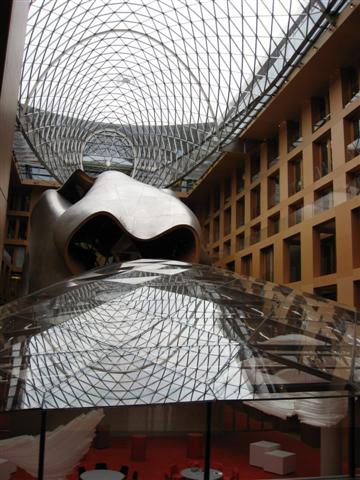
It was designed by Frank Gehry and I’ve heard people say it reminds them of a horse’s head. I don’t know if I can see that…but, to each his own. There are private apartments behind the work of art and the rooms on the side are actual office buildings. I’ve heard it looks pretty cool if you’re in the basement looking up, but you can’t go in unless you have a pass to get through security.
c. Reichstag
Reichstag is behind the Brandenburg gates and is home of the Germain parliament. You can actually go into the building and watch parliamentary proceedings, but David and I didn’t have time to do it (you have to reserve a spot the day before). The building suffered some damage from World War II, but in the 1990’s, was remodeled by British architect Norman Foster in the 1990s and features a glass dome over the session area:

d. Holocaust Museum/Memorial
The Holocaust Museum/Memorial is in the general vicinity of the Brandenburg Gates and Reichstag. There was a lot of controversy over construction and design of the memorial, but it was finally unveiled in 2005:

There are 2,700 stone slabs, which was designed by Peter Eisenman in 1999. There aren’t any names on the stone slabs (the designers feared it would look too much like a graveyard, which they didn’t want), but it’s meant to be somewhere people would go everyday, not just for holy reasons. Underneath the memorial is a museum:
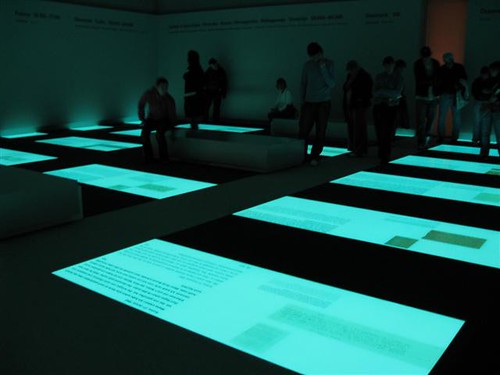
This mirrors the idea of the stone slabs above – on each of these slabs, there is a postcard/letter/some form of correspondence between family members separated due to the Holocaust. It’s very sad to read the desperation some of the letters, especially the ones children write to their parents.
Here’s a picture of the areas in Europe where Jews were affected:

The museum is free and it doesn’t take too long to go through (there are only four rooms, one of which is a darkened room with a projector listing the names of each person that died from the Holocaust and their age).
2. Check point Charlie
Check point Charlie is the crossing point between East Berlin and West Berlin, and important area during the Cold War. There’s a private museum that has artifacts from East and West Berlin:
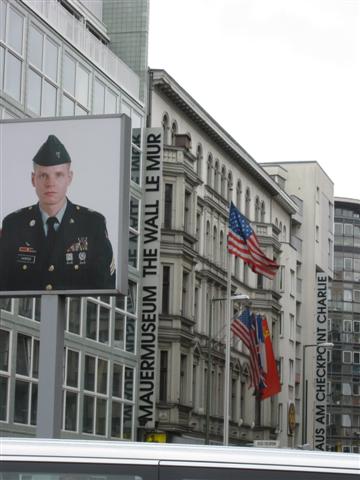
The museum shows a lot of ways people tried to flee from East Berlin (if you were successful, you were allowed to stay in West Berlin, which was safe). One family escaped by a hot air balloon that they built themselves:
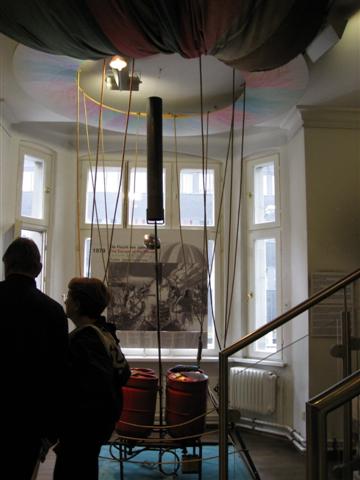
There are a lot of heroic tales – a bunch of them were of boyfriends saving their girlfriend’s (and the girl’s entire family) by smuggling them out through cars, guys that dressed up as US soldiers to deceive Russian soldiers, and true tales of bravery.
3. Berlin Zoo
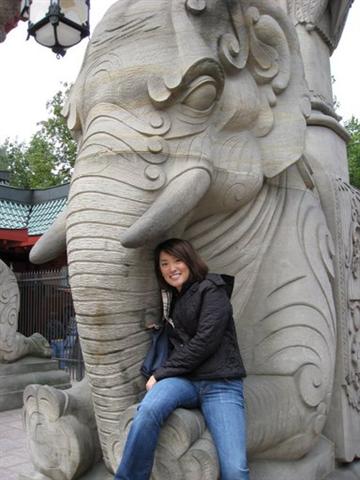
David and I took a morning to visit the Berlin Zoo, one of the largest zoo’s in Germany with the largest amount of species in the world:
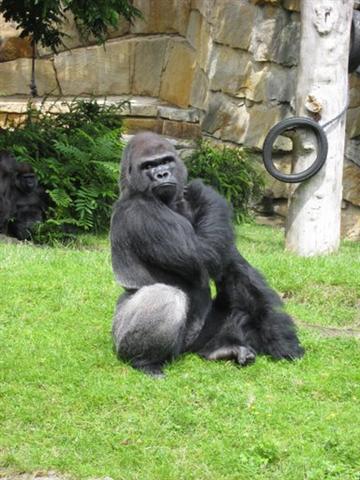
The zoo has a LOT of gorillas:
When I travel, I usually don’t go to zoo’s (I dunno…too kiddie like, maybe?) but it was a great excursion and if you go to Berlin, you definitely have to visit the zoo. Recently, the zoo’s been in the paper a lot because of Knut, a cute polar bear that was rejected by his mother. Some people say the zoo should’ve killed Knut (oh no!) but zoo keepers decided against it. I mean, Knut was the first polar bear born at the Berlin Zoo in over 30 years! Thomas Dörflein, shown in the picture below, took on the task of taking care of Knut 24 hours a day while he was still a baby cub (he was born the size of a little guinea pig):
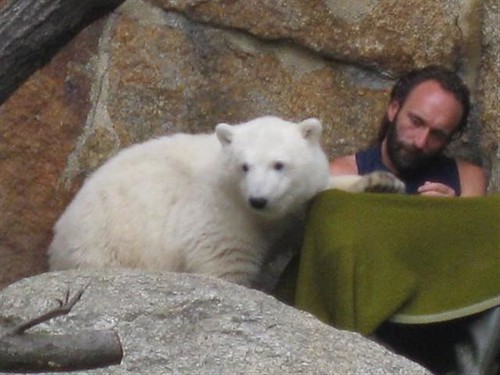
Knut and Thomas were playing peekaboo with the blanket (it was so cute) and whenever Thomas hid himself, Knut would paw at the blanket to find his friend!
Another great area is the petting zoo – David and I stopped by and said hello to some animals:
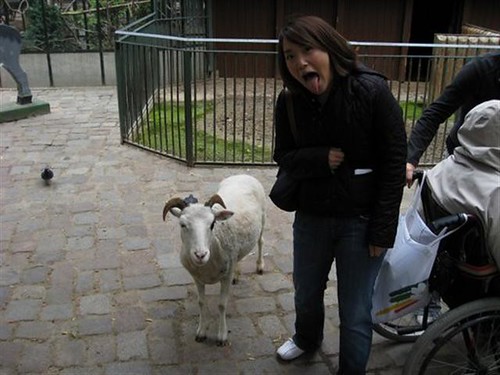
I was about to pet this fella (I was already a little scared to pet him) and right when I was about to pet him, he let out this huge BAAAAA and then stuck his tongue out at me! He wouldn’t do it again for my picture, but I literally jumped and my brother thought it was the funniest thing ever.
The weather in Berlin this summer has been very cool and somewhat wet. On the day we went to the zoo, it would shower on and off – scaring the animals, especially this tiger:
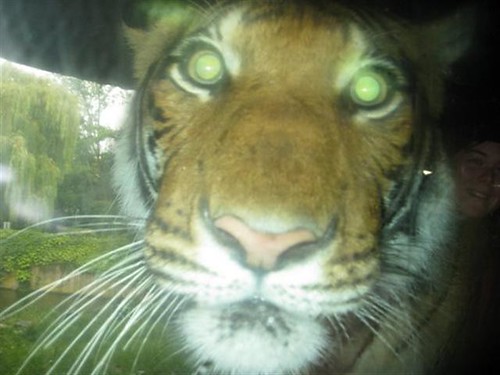
There’s an indoor area where you can see all of the animals that are inside cages or through glass windows and this tiger just get pacing back and forth. I snapped that picture when the tiger was inches away from my face!
4. Potsdamer Platz
Potsdamer platz is a major intersection in the center of Berlin – actually, it has one of the first traffic lights in Germany:
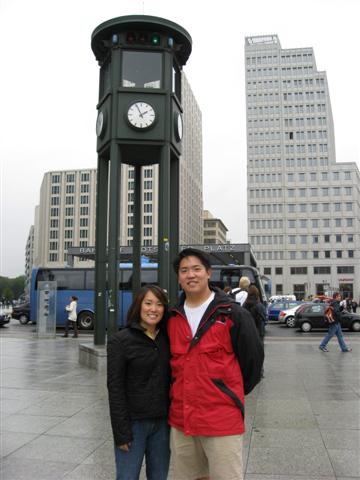
And the Sony Center, where the European headquarters are located:
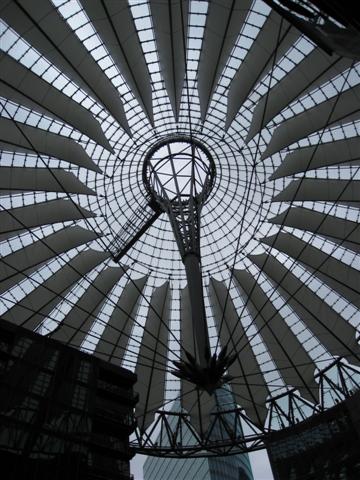
Potsdamer Platz is actually close to Reichstag and the Brandenburg Gates, so you can theoretically walk to all of these places (and we walked to Checkpoint Charlie from here, too).
5. The Pergamon Museum
The Pergamon Museum is based off of the ancient Greek City, Pergamon. The museum houses original-sized, reconstructed monumental buildings such as the Pergamon Altar, the Market Gate of Miletus, and the Ishtar Gate, all consisting of parts transported from the original excavation sites:
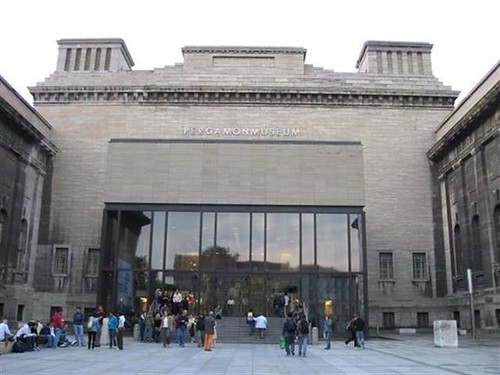
When you initially walk in, you go past the gift shop, security, etc, walk around a hall, and then enter the massive reconstruction of the Pergamon Altar:
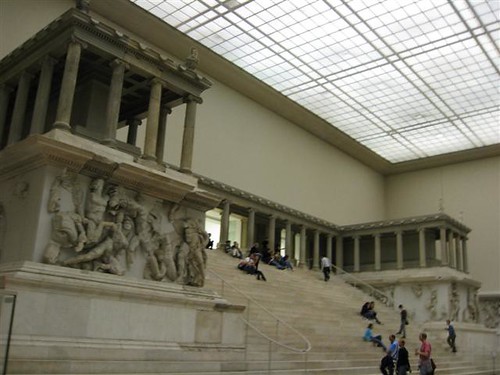
It is really quite breathtaking!
A model of the Pergamon Altar (how it used to be):
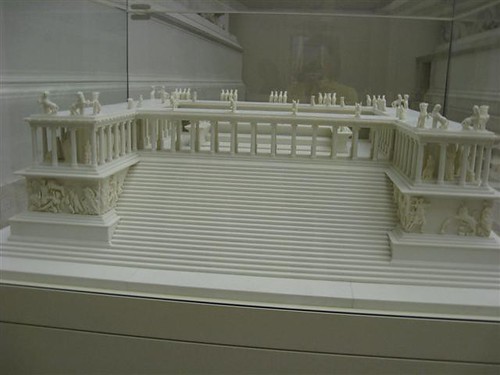
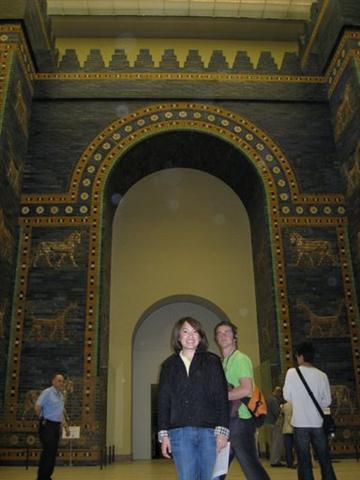
Inside, you can walk around all of the ruins and it’s so magnificent!! The Market Gate of Miletus was actually under construction when we visited, but we did get a chance to see the Ishtar gate:

The Pergamon Museum also has a large Islamic collection, which features a ton of antique rugs. It takes a couple of hours to get through the entire museum, but it’s definitely worth the walk.
I’ll be back with updates of other notable places to visit while you’re in Berlin, things to eat, and little treats that make Berlin special. Hope you enjoyed the update!


Reader Comments
You steal my Top Five List idea again and I will cut you.
Plus, check out the Late Show after your local nightly news on CBS.
Hi Grace,
Your updates about Berlin are amazing. Thanks so much for putting in all the hard work!
Joshua
keep those balls in the air!
Enjoyed your travelogue. You did a great job and it sounds like you had a spectacular time.
simple to read and more importantly, very useful!!
You’re HOT!
I really enjoyed reading your travelouge! I was doing an English project on the top 5 places we wanted to travel to before we were 80 years old. I knew Germany was definatly one of the places I wanted to visit, but unfortunatly, I couldn’t figure out why. Your travelouge helped me remember why I wanted to go so badly. It also was very helpful in teaching me things about Germany that I didn’t know before. The best thing about this is that it’s also not one of those pieces that has a 15 letter word that I didn’t understand every two words.
Thanks a bunch!
P.S. Have fun on future trips!
Thank to you detail introduction of Berlin , it really help alot for 1st timer going there. I am going in April 09 so I will go to these places…thank very much.
your hot!!!!!!!
Thank you for showing your pic’s.There great! My husband and I are heading to Germany in late aug. Your pic’s and info has been very helpful. Thanks
My name is Adriano Kalist, I am a Tanzanian citizen aged 30 Years old. Curent i am working as a Executive Secretary of an association called CHRISTIAN YOUTH NETWORK. For the grace of God i have been invited to in Berling German to attend to the NGO Forum Global partiners in Action early in september this year. I have seen the impontant to have atleast some one to know before i come over there.
Please connect me to any good friends who can became my frinds.
Looking forward to hearing from you
Regard
Adriano Kalist
Hi
I’ve just begenning to prepare my guide to Berlin and your site was the first I entered and I am very pleased with your kindness of sharing your pics.
Thaks
Rici
hi there. Thanks for your info I found it easy to read and as I’m heading to Berlin this week I think il follow your top 5 must see,s
Thanks
Yvonne
dear john, you used the wrong “your”…. just thought you should know… that is all
Very useful…. many thanks….
Hi thanks for posting this its very helpful… I’m planning a trip this summer and i only have 2 days in Germany (Berlin)do you think that will be enough time to see these top 5 places?
Hi Bhavika – Yes, I think 2 days is enough to see the top 5 places – but don’t rush through them!
Thanks a lot is a great idea to know where to go in Berlin is my first time to go to Europe, your report is amazing.
Great report and pics! Very helpful in my planning. You are a good writer – fun and interesting.
Hey, I liked this article. I don’t usually go all the way down to the last line, honestly, but this seemed captivating and very entertaining. BTW, you look lovely in the pics, very joyful.
Regards
I’m going to Berlin in a few days to take some pictures and you gave me some great ideas (except for the zoo, which I’m totally against it). Thanks!
I am currently in Berlin for a few days. Yesterday we visited the zoo. Unlike you, I was very disappointed to see that the animals were in tiny cages or small compounds, whereas the people had magnificent gardens to stroll around.
Berlin is an amazing city, definitely worth visiting. It is immaculately clean and the people are friendly.
Thank you so much! It’s very useful. We had no time to plan our trip and we’ll rely on your advice 🙂
Great Article thanks for that, clear and precise and alot of information 🙂
Thank you so much . It was very useful. You explained everything very nice.
Thank you for a very interesting article – we are travelling to Berlin for 4 days next month and found your information very useful – I intend to print it and take it with us!
Hi loved your guide on Berlin. I am going there this month with my three sisters and am looking forward to following your guide.
My wife and I will be in Berlin this September to attend tradeshow.
Is one day enough to visit the sites you recommended?
How about food? Any suggestions where to dine?
Many thanks!
Hello there! It looks as though we both have a interest for the
same thing. Your blog, “Top Five things to see in Berlin, Germany | gracenotes nyc” and mine are very similar.
Have you ever thought of authoring a guest write-up for
a similar blog? It will unquestionably help gain exposure to your blog (my site recieves a lot of targeted traffic).
If you are interested, e-mail me at: floyd_anglin@arcor.
de. Many thanks
Thanks for all the information. Really useful and enjoyed your journey in Berlin.
R.I.P. Knut! Some good points here! I love Berlin and go as often as possible. I’ll never run out of things to do though – the list is endless! I have a few more things here: http://blog.lowcostholidays.com/2012/08/16/5-essential-things-to-do-in-berlin/
Great job, thank you. You are a good example how to write articles both educational and entertaining. For your next trip I would like to recommend you two more sights – a must visit to one of underground bunkers – a tour is just 1.5 hours long, but really impressive. And the second sight – go to Potsdam royal park and Sansusi palace.
Thank you for these tips, Grace! I’m in Berlin right now and am going to check out those I’ve never been to before!
CONGRATULATIONS,
THIS IS GREAT.
GOD BLESS YOU
Hi…Many thanks for the wonderful info….Could you direct me to an area to stay in Berlin …that is a central location for bus and tram but need to take the train around Germany….Big Hugs,Ellen
Thanks for this Grace. Arriving in Berlin today for 5 days…if you have any more info for me let me know:)
Thanks for the wonderful info 🙂
Thank you !!!Great Job!
Thanks a lot for this advice, very interesting top five places to visit.
One thing how about the people friendly or not really,
I put a scarf I want to visit Germany I hope people accept other cultures if they see them.
🙂